
Façade defects · Fire risk
Combustible insulation behind cladding: causes, risks and repair.
How foam insulation such as PIR, PUR and phenolic ends up behind cladding and render, how it is identified by opening up the wall, and what a FRAEW makes of it.
| At a glance | |
|---|---|
| What it is | Insulation in the external wall that can burn, such as PIR, PUR, phenolic or polystyrene boards. |
| Main risk | It can add fuel to a fire inside the wall cavity or behind render. |
| Common on | Rainscreen and rendered blocks built or refurbished from the 1990s to the 2010s. |
| Usually spotted by | A FRAEW or an intrusive investigation, sometimes from records or vents. |
What the problem is
Most external walls built in the last 30 years contain insulation. Mineral wool is non-combustible. Foam boards such as PIR, PUR, phenolic and expanded polystyrene insulate well at a smaller thickness, but they can burn. Since 2018 the law has restricted combustible materials in the external walls of many residential buildings over 18 metres, and guidance for lower buildings has since been tightened. Buildings designed before those changes may still contain them.
How to recognise it
- Drawings or specifications that list foam insulation boards.
- Foil-faced boards visible through vents, panel joints or damaged areas.
- External wall insulation with render that sounds hollow or is unusually thin.
- No product information for the insulation at all.
- Previous refurbishment that added insulation to the outside of the wall.
Why it happens
- Thinner boards chosen to meet energy targets without thickening the wall.
- Products substituted on site for cost or availability.
- Refurbishments that added foam-based external wall insulation to older blocks.
- Different insulation used on different parts of the same building.
Why it matters
- Fire safety. PAS 9980 gives the combustibility of the insulation a lot of weight in the risk rating.
- Not automatically a failure. PAS 9980 is risk-based: the building's height, layout, cavity barriers and fire strategy all count.
- Lending and sales. Lenders and valuers often ask what insulation is in the wall before they will lend.
How we investigate it
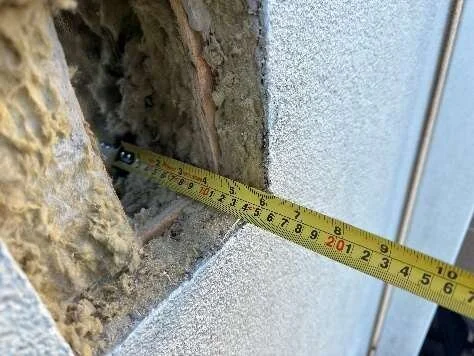
We open up each wall type at representative locations, including floor lines and window perimeters. At each opening we identify the insulation, record its thickness, facing and fixing, and look for product markings. Where the type is uncertain, we take a sample. Cavity barriers are checked at the same openings, so one visit answers both questions.
How it is put right
- Often nothing: where mineral wool is proven, or the overall risk is tolerable, no works are needed.
- Replacement: where the FRAEW finds the risk is too high, the insulation is replaced as part of a remediation scheme.
- Interim measures: the fire risk assessor may recommend temporary measures while works are planned.
The cost of finding out depends on the building's height, the number of wall types, the type of powered access needed and the number of days on site.
From our investigations
Examples from our own work. Client and building details are withheld.
See our published case studies
What to send us
The address, height or number of storeys, any drawings or insulation specifications, the fire risk assessment and any previous FRAEW or EWS1. Email enquiries@mtconsult.co.uk, use our contact form or call 0800 048 5229. We typically respond within one working day.
Frequently asked questions
Does PIR insulation mean my building fails?
No. PAS 9980 is risk-based. The insulation is weighed with the building's height, cavity barriers, layout and fire strategy.
Can you identify insulation from a small opening?
Usually yes: its type, facing and product markings. Where it is uncertain, we take a sample.
Is foam insulation behind render a problem?
It can be. External wall insulation systems vary, so each system is opened up and appraised on its own evidence.
Related
Talk to us
Not sure what insulation is in your walls?
Our in-house contracting team provides the access and opening-up, so you have one point of contact.