
Façade defects · Fire risk
ACM and HPL cladding panels: causes, risks and repair.
What ACM and HPL panels are, how to tell them apart from other metal and laminate cladding, and what happens when they are found.
| At a glance | |
|---|---|
| What it is | Aluminium composite (ACM) or high-pressure laminate (HPL) panels used as cladding or balcony infill. |
| Main risk | ACM with a polyethylene core and some HPL can spread fire rapidly over the outside of a building. |
| Common on | Residential and student blocks built or re-clad in the 2000s and 2010s. |
| Usually spotted by | A FRAEW, an EWS1 survey or a lender's valuer. |
What ACM and HPL are
ACM panels are two thin aluminium skins bonded to a core. When the core is unmodified polyethylene, the panel can burn fiercely, and since 2022 these panels have been banned on new buildings in England regardless of height. HPL panels are made from layers of wood fibre or paper bonded with resin. Standard HPL is combustible; fire-retardant grades perform better but are still not non-combustible.
How to recognise it
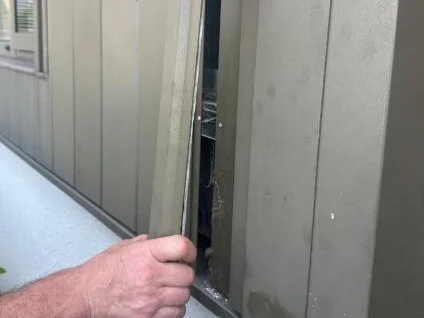
- ACM: thin, flat, often folded into trays, with a smooth metallic or coloured finish. A cut edge shows two metal skins with a core between.
- HPL: solid flat boards, often timber-effect or coloured, with a dark core at the edges.
- Look-alikes: solid aluminium sheet, steel-faced insulated panels and fibre cement can look similar from the street.
Why it happens
- Chosen for appearance, flatness and cost, before restrictions were tightened.
- Used for balcony infills and feature panels as well as whole elevations.
- Substituted for a specified product during construction.
Why it matters
- Fire safety. ACM with a polyethylene core is the highest-risk cladding found on UK buildings.
- HPL is case by case. Its risk depends on its grade, where it is, and the rest of the wall, which is what a PAS 9980 appraisal weighs.
- Funding. Remediation of unsafe cladding on eligible buildings in England may be funded. See our Cladding Safety Scheme guide.
How we investigate it
We identify panels by inspecting their edges, removing panels where needed and looking for product markings. Where the core is uncertain, a sample can be sent for laboratory testing. We then record where each panel type is used and appraise the whole wall to PAS 9980, because the panel is only one part of the risk.
How it is put right
- ACM with a polyethylene core: usually replaced with non-combustible panels as part of a remediation scheme.
- HPL: replaced where the FRAEW finds the risk is too high; in some buildings it can remain.
- Project management: we can manage the remediation works from design to completion.
From our investigations
Examples from our own work. Client and building details are withheld.
See our published case studies
What to send us
The address, height, photos of the panels, any drawings or cladding specifications and the fire risk assessment. Email enquiries@mtconsult.co.uk, use our contact form or call 0800 048 5229. We typically respond within one working day.
Frequently asked questions
How can I tell if my cladding is ACM?
Not reliably from the street. A cut edge or a removed panel shows the build-up, and a laboratory test confirms the core.
Is all HPL dangerous?
No. Its risk depends on its grade, where it is used and the rest of the wall. A FRAEW weighs all of these.
Will funding pay to replace it?
It may, for eligible buildings in England. Our Cladding Safety Scheme guide explains the process.
Related
Talk to us
Need your cladding identified?
Our in-house contracting team provides the access and opening-up, so you have one point of contact.