
Façade defects · Masonry
Brickwork cracking and wall tie corrosion: causes, risks and repair.
What stepped, vertical and horizontal cracks in brickwork mean, how corroded wall ties are found, and the repairs from crack stitching to remedial ties.
| At a glance | |
|---|---|
| What it is | Cracks, bulging or spalling in brick walls, and corrosion of the ties that hold the two leaves of a cavity wall together. |
| Main risk | Falling bricks, water ingress and, in serious cases, instability of the outer leaf. |
| Common on | Brick-faced blocks of all ages, especially long elevations without movement joints. |
| Usually spotted by | Managing agents, condition surveys and intrusive investigations. |
What the cracks tell you
Brickwork cracks for different reasons, and the pattern usually points to the cause. Stepped cracks through the joints often mean movement. Horizontal cracks repeating every few courses can mean corroding wall ties are expanding in the mortar. Cracks at window heads can point to failing lintels.
How to recognise it
- Stepped cracks running through the mortar joints.
- Vertical cracks, often near corners or at regular spacing.
- Horizontal cracks every few courses.
- Bulging or leaning sections of wall.
- Spalled brick faces and open or crumbling joints.
Why it happens
- Thermal and moisture movement with no movement joints.
- Corrosion of older wall ties.
- Frost damage to porous bricks.
- Corroding steel lintels and support angles.
- Ground movement, less often.
Why it matters
- Safety. Loose bricks can fall.
- Stability. Without working ties, the outer leaf can bulge or detach.
- Water. Open cracks let water into the cavity.
How we investigate it
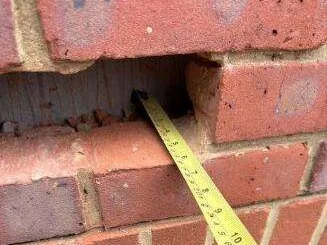
We map and photograph every crack, and set up monitoring where movement may be ongoing. Bricks are removed at key locations to inspect the cavity, ties, insulation and lintels directly, with a borescope to see further. Cavity depths and tie condition are recorded location by location.
How it is put right
- Crack stitching with helical bars.
- Remedial wall ties, with old ties isolated or removed.
- New movement joints.
- Local rebuilding and repointing.
- Lintel or support angle replacement.
From our investigations
Examples from our own work. Client and building details are withheld.
See our published case studies
What to send us
The address, photos of the cracks, the building's age, and any previous reports or monitoring. Email enquiries@mtconsult.co.uk, use our contact form or call 0800 048 5229. We typically respond within one working day.
Frequently asked questions
Are all cracks serious?
No. Fine cracks are common. The pattern, width and whether they are growing decide what to do.
How are wall ties checked?
By removing bricks and using a borescope to see the ties in the cavity.
Do brick slips crack the same way?
They can, and they also fail by debonding. They are covered in our condition surveys.
Related
Talk to us
Cracks in your brickwork?
Our in-house contracting team provides the access and opening-up, so you have one point of contact.