
Façade defects · Masonry and stone
Stone and cast-stone decay: causes, risks and repair.
Cracking, spalling and erosion in stone and cast-stone façades: what causes them, when they become a safety risk, and how a condition assessment plans the repairs.
| At a glance | |
|---|---|
| What it is | Cracking, spalling, erosion and staining of natural stone or cast stone on a façade. |
| Main risk | Pieces falling onto the street, and water getting into the building. |
| Common on | Pre-war offices and civic buildings, and retained façades on redevelopments. |
| Usually spotted by | Managing agents, insurers, or debris found at the foot of the building. |
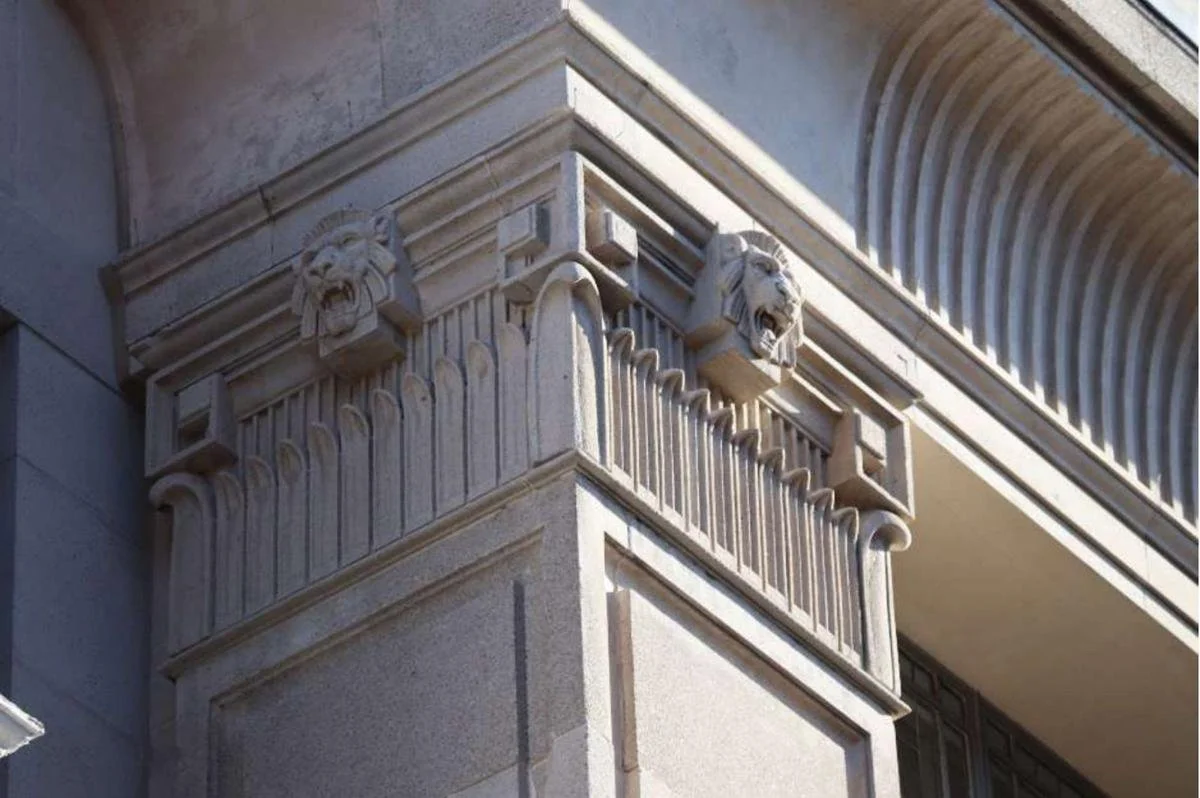
Natural stone and cast stone
Natural stone is quarried. Cast stone is a concrete made to look like stone, widely used from the early 20th century for cornices, pilasters and mouldings. They decay in different ways, so repairs that suit one can harm the other.
How to recognise it
- Cracks, especially along the line of hidden metal fixings or reinforcement.
- Spalling, where the face breaks away in pieces.
- Rust staining bleeding from joints or cracks.
- Eroded or crumbling surfaces, and lost detail on carvings and mouldings.
- Open or failed joints on cornices, ledges and copings.
- Dark streaks and biological growth where water runs off sills and ledges.
- Old patch repairs that have cracked, debonded or no longer match.
Why it happens
- Corroding steel. Iron cramps, dowels or reinforcement rust and expand, cracking the stone around them.
- Water concentration. Sills, cappings and fixings direct water onto the same areas year after year.
- Frost and salts. Water in the stone freezes or deposits salts that break up the surface.
- Bedding. Natural stone laid with its layers facing outwards can peel away in sheets.
- Inappropriate repairs. Hard cement mortars and impermeable coatings trap moisture and speed up decay.
Why it matters
- Public safety. A loose piece of cornice over a pavement is a serious risk, and owners have a duty to manage it.
- Water ingress. Open joints and cracked ledges let water into the structure behind.
- Cost. Small repairs left unplanned become large ones, and emergency scaffolding is expensive.
- Heritage. On listed buildings, repairs need the right materials and may need consent.
How we investigate it
We start from street level, inspecting each elevation and using a long lens or drone for ledges, cornices and mouldings. Every observation is photographed and located so contractors can find it again. Where there is a risk of loose material, or the findings need confirming, we inspect close-up from powered access and sound the stone by tapping it. The report ranks every recommendation by priority and timescale, ready for the planned maintenance programme.
How it is put right
- Make safe: remove or secure loose pieces at once where needed.
- Water management: repair joints, add or renew lead weatherings to cornices and ledges.
- Local repair: mortar repairs or new stone pieces, matched to the original.
- Corroded fixings: replace with stainless steel where cracking is caused by rusting metal.
- Specialist cleaning: by a method suited to the material.
- Periodic inspections: close-access checks at set intervals.
From our investigations
Examples from our own work. Client and building details are withheld.
See our published case studies
What to send us
The address, photos of any cracking, staining or fallen pieces, the listing status and any previous reports. Email enquiries@mtconsult.co.uk, use our contact form or call 0800 048 5229. We typically respond within one working day.
Frequently asked questions
Is cracked stone dangerous?
Not always, but cracking near edges, over walkways or along hidden fixings should be checked promptly.
Can it be inspected without scaffolding?
Usually yes for a first assessment, from street level, a long lens or a drone. Close access is added where needed.
How often should a stone façade be inspected?
It depends on its condition and setting. The report sets a frequency for periodic inspections.
Related
Talk to us
Concerned about a stone façade?
We assess stone and cast-stone elevations and give you a prioritised, costed plan.