
Façade defects · Water ingress
Curtain walling leaks: causes, risks and repair.
Why glazed curtain walling leaks, how hose testing and strip-back find the real source, and the repair options from local resealing to refurbishment.
| At a glance | |
|---|---|
| What it is | Rainwater getting through a glazed curtain wall into the building. |
| Main risk | Damage to finishes, floors and services, and repeated failed repairs. |
| Common on | Offices and apartment blocks with glazed façades, especially 15 years old or more. |
| Usually spotted by | Occupiers and facilities managers, after wind-driven rain. |
How curtain walling keeps water out
Most curtain walling is drained and ventilated. The outer seals keep most rain out, and any water that gets past them is collected in the framing and drained back out through slots. Leaks happen when water gets past the inner line of seals, or when the drainage route is blocked.
Curtain walling is either stick-built (assembled on site from mullions and transoms) or unitised (factory-made panels joined on site). The weak points differ, so the investigation starts by knowing which you have.
How to recognise it
- Staining or tide marks on frames, glass edges or spandrel panels.
- Water in perimeter heating trenches or under floor grilles at the façade line.
- Damp carpets or swollen skirtings near the glazing.
- Leaks that appear only in wind-driven rain, or on one elevation.
- Leaks that return after repairs.
Why it happens
- Failed seals at framing junctions, especially cruciform joints behind the pressure plates.
- Shrunk, hardened or displaced gaskets.
- Blocked or missing drainage slots.
- Failed seals where the curtain wall meets the roof, slab edge or other wall types.
- Stack joint failures between unitised panels.
- Repairs that sealed the outside face but never reached the cause.
Why it matters
- Building damage. Water reaches floors, ceilings, insulation and electrics.
- Wasted spend. Surface resealing often fails, so the same leak is paid for again.
- Disputes. Owners need to know whether the cause is the original installation or age, for warranty or claims.
How we investigate it
- Desk study and internal survey. We obtain the system manufacturer's installation guidance and map internal staining to target the testing.
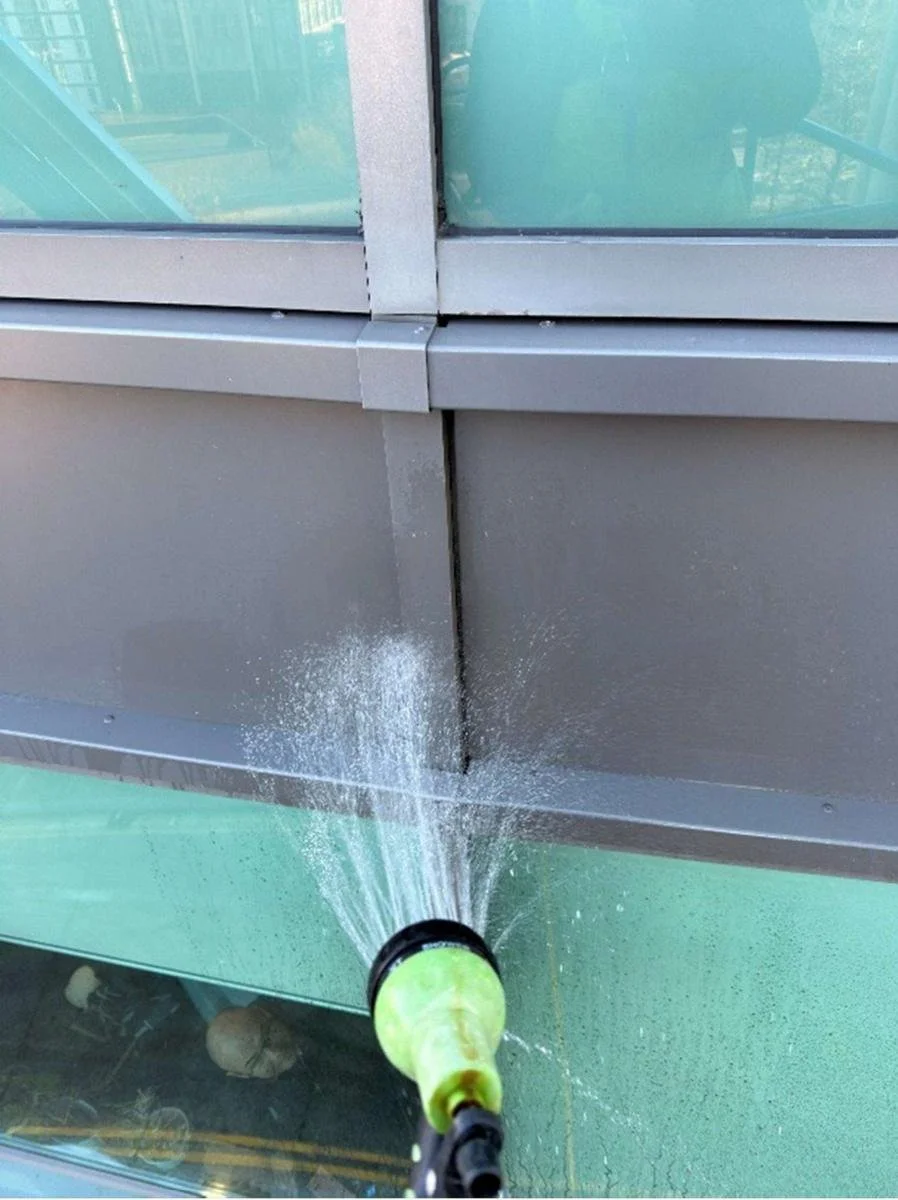
- Hose testing. Controlled testing to CWCT Section 9 and AAMA 501 reproduces the leak and locates it.
- Strip-back. Our in-house team removes cover caps and pressure plates at the live locations to see the junctions as installed, and checks them against the manufacturer's guidance.
- Trial repair and re-test. Where possible we make a local repair and re-test it, so the fix is proven before the report is written.
How it is put right
- Local resealing of junctions to the manufacturer's details.
- Gasket replacement and clearing of drainage paths.
- Targeted repair of the affected bays.
- Full refurbishment or replacement, where the system is near the end of its life.
The cost depends on the building's height, the number of affected bays, the type of powered access needed and the number of days on site.
From our investigations
Examples from our own work. Client and building details are withheld.
See our published case studies
What to send us
The address, where and when the leaks appear, photos of the staining, any previous repair reports and the curtain wall system name if known. Email enquiries@mtconsult.co.uk or call 0800 048 5229. We typically respond within one working day.
Frequently asked questions
Why does my curtain wall still leak after it was resealed?
External resealing often misses the cause, which is usually inside the framing junctions.
How long does a water test take?
A targeted test usually reproduces a leak within minutes once the right location is found. On a recent office investigation it took about three minutes.
Is it a defect or wear and tear?
Testing and strip-back show which. Comparing the junctions against the original installation guidance answers it.
Related
Talk to us
A leak that keeps coming back?
We test, open up and prove the repair before we report, with our own access and strip-back team.